Putman Mountain Observatory


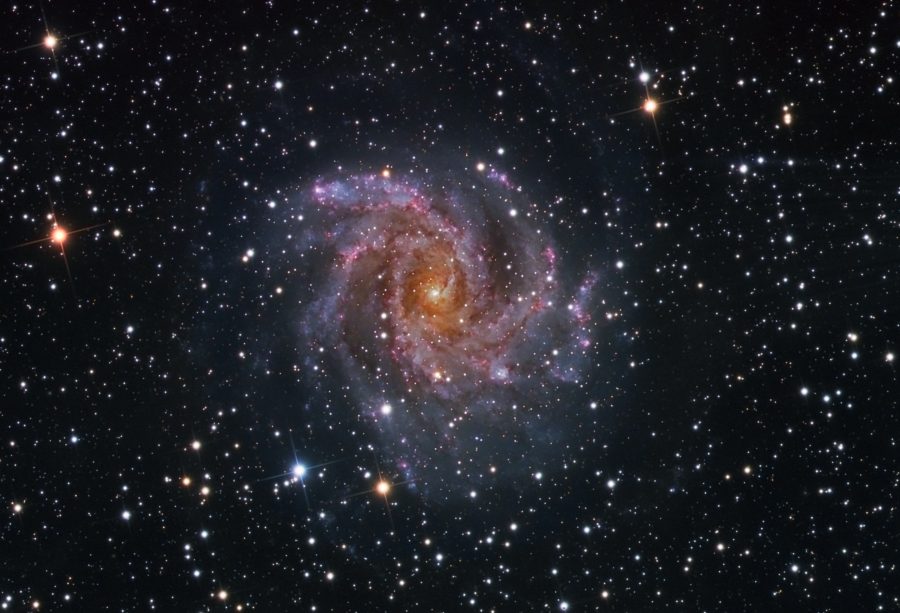
The Whirlpool Galaxy (also known as M51a, or NGC 5194) is an interacting grand design spiral galaxy that is estimated to be approximately 30 million light years from our own milky way galaxy.  It is located in the constellation Canes Venatici near the Big Dipper.  It is famous because of the very defined spiral arm structure that is visible from our perspective because the galaxy is oriented “flat-on” toward us.  A black hole, surrounded by a ring of dust, is thought to exist at the heart of the spiral.  The Whirlpool Galaxy has a companion designated M51b (also designated NGC 5195).

Decades ago, it was not known with certainty whether the companion galaxy M51b was a true companion, or another galaxy passing at a distance. The advent of radio astronomy and subsequent radio images of M51a unequivocally demonstrated the reality of the interaction.  Recent simulations bear out that M51's spiral structure was caused by M51b passing through the main disk of M51a about 500 to 600 million years ago. In this model, M51b came from behind M51a through the disk towards the observer and made another disk crossing as recently as 50 to 100 million years ago until it is where we observe it to be now, slightly behind M51a.  The faint glow that spans between M51a and M51b are tidal streams of stars that have been pulled out of the spiral structure and pulled along the path of the interaction between the two.  The tidal streams are extremely faint and required an exposure of over 10 hours over several nights to capture their structure.

Far in the distance, across intergalactic space, you can see other galaxies that are marked in the picture.  These include IC 4277, IC 4288 and IC 4282


Current Weather Information


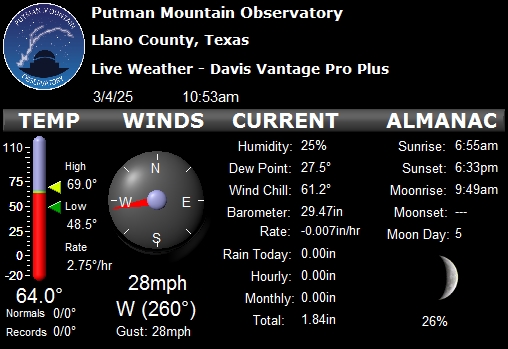
Live Weather data posted to Weather Underground. 


Wunderground Weather Map


Current Forecast for Fredericksburg, Texas


Historical Weather Information for Putman Mountain Observatory


Satellite Predictions for Putman Mountain Observatory


Sun and Moon Data for Putman Mountain Observatory


Today's Highs and Lows:


Selected Readings for Last 7 Days:


Current Sky

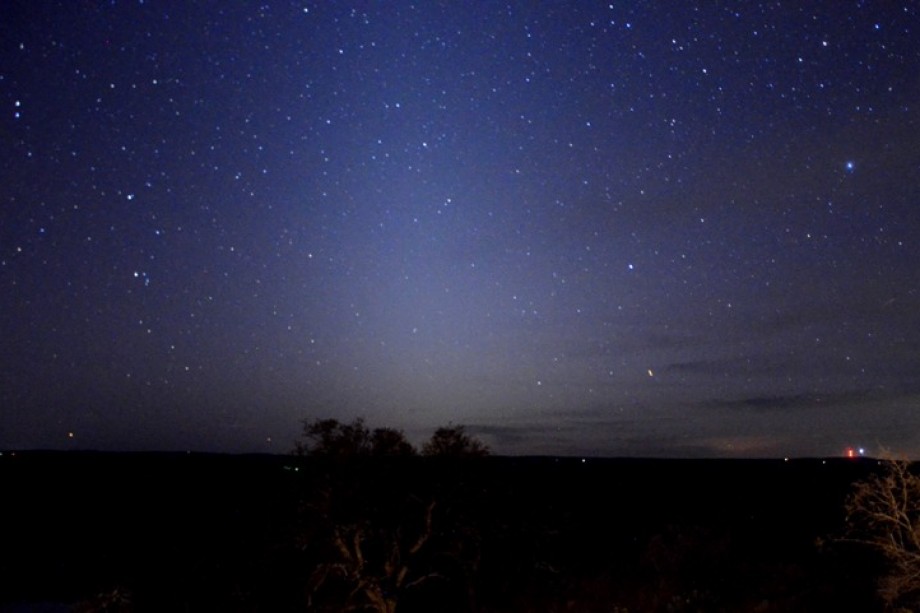
The image above is updated every few minutes from the Observatory's All Sky Camera.  North is up.  West is to the right. 


Cloud Monitor


Dark Sky Monitor

  Current Mag/Sq Arcsec:

   Updated every 15 minutes from dusk to dawn


This chart shows the last current reading from the Sky Quality Meter (SQM). These readings are updated every 15 minutes.  The SQM is an ethernet connected device made by Unihedron and is monitored by SQM Reader Pro Software by Knightware.  The SQM measures sky brightness each night and provides a quantitative analysis of sky darkness from night to night.  Fluctuations in relative darkness levels are caused by the phases and position of the moon in the sky and the milky way as it passes over the SQM's field of view.   The SQM measures darkness in magnitudes per square arc second  (Mag/Sq Arcsec) of sky.  The chart also converts the Mag/Sq Arcsec reading into a theoretical Naked Eye Limiting Magnitude (NELM), which represents the faintest magnitude object that would be visible to the naked eye.  This is a very dark site with naked eye limiting magnitudes ranging from 6.5 to 7.0 with no moon.


Historical Mag/Sq ArcSec:

    Updated every 15 minutes from dusk to dawn


The rising and setting of the moon in the sky will affect the dark sky monitor readings.  Moon rise and set times are indicated to explain fluctuations in relative sky darkness.


This chart shows historical sky darkness readings over the last several hours.  A new plot is marked every 15 minutes.  No readings are taken after sunrise.


Clear Sky Clock Forecast


Jetstream Forecast (30,000 ft / 300mb)


Wunderground Radar (San Antonio)


NOAA IR Radar


Hit Counter